How to Use AI Without Losing Your Brand Voice
Why AI drafts drift towards the generic, the four things to check before you publish one, and how to set Hyvo up so it starts closer to you.

Quick guide
Give the model your rules before it writes, ask for one change at a time, and run every draft through four checks: the opening, the claims, the words you never use, and the specifics.
- Fill in brand memory properly, especially the field about what you never say.
- Brief it specifically. "Write me a post" gets you an average post.
- Ask for one change at a time when you're refining. Piled-up requests average out into mush.
- Before publishing, check: does the opening make a real claim, are the claims true, are the banned words gone, are the numbers and names still there?
- When you find yourself making the same edit twice, add it to your rules instead of fixing it a third time.
The full walkthrough is below.
AI drafts fail in a way you can spot from across the room. Grammatically fine, sensibly structured, completely anonymous. Read three of them and you couldn't tell which company wrote which.
There's no mystery to it. A model produces the most likely next sentence, and the most likely sentence is the average one. Sounding like yourself means being specific, and specific is the opposite of likely.
So this is about closing that gap: before the draft, during, and after.
Why drafts drift generic
Three things go wrong, and each has a fix.
The brief was vague. "Write a post about our new feature" gives the model nothing specific to work with, so it reaches for the shape of a feature announcement. That shape is identical for every company on earth.
The rules were never written down. A model has no way of knowing you never say "excited to announce" unless somebody tells it.
Editing averaged it out. "Make it better" nudges a draft towards the mean. Every vague refinement pulls harder in the same direction.
Before the draft: hand over your rules
Hyvo applies your brand memory to everything it writes, so most of what comes back is decided before you type anything at all.
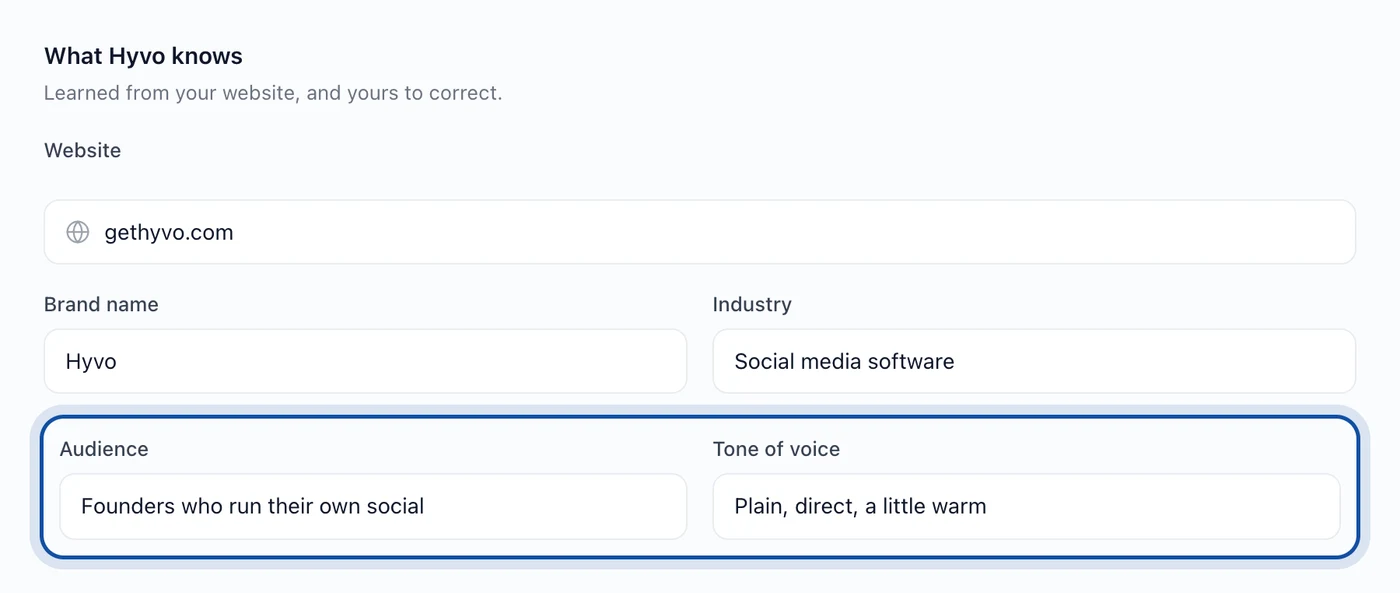
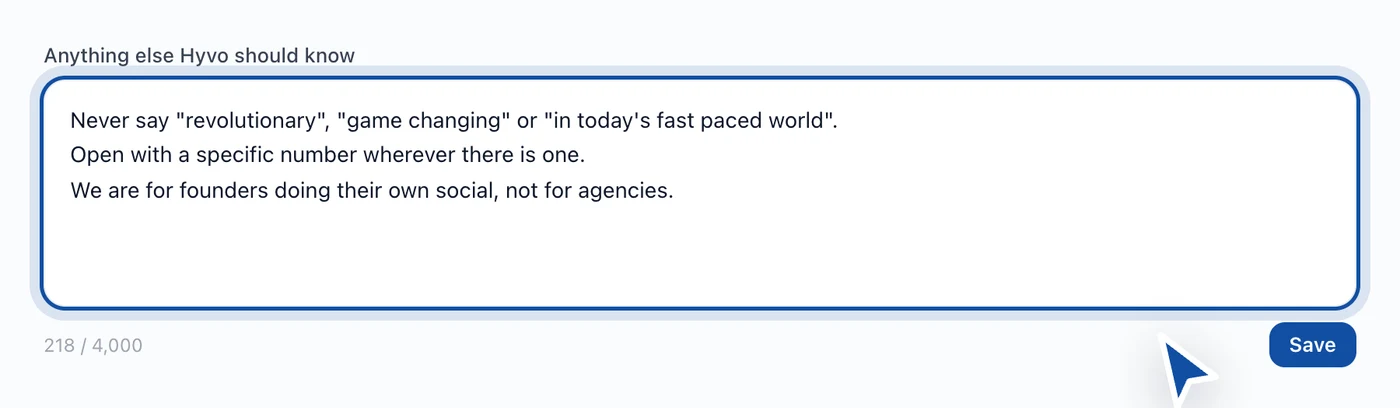
The field that changes output most is the last one, Anything else Hyvo should know, because that's where the negative rules live.
Next to it, Instructions for Hyvo holds standing rules for what it should do whenever it writes or schedules. If you haven't set either up yet, creating a consistent brand voice covers what to put in them.
During: brief it like a person
The prompt that gets you a usable draft looks like the brief you'd give a freelancer. Three parts.
- The claim. What's actually true and worth saying. "We cut our calendar by 40% and reach went up."
- The reader. Who it's for and what they already know.
- The shape. Which network, how long, what the opening should do.
Compare "write a LinkedIn post about our content strategy" with "LinkedIn, five lines. Claim: we cut our calendar by 40% and reach went up. Reader: founders doing their own social. Open with the number." The second one can't produce the generic version, because the generic version doesn't contain a 40%.
In the composer, AI Assist works against whichever channel is in the preview, so it aims at that network's length and habits rather than a generic average.
Refining: one change at a time
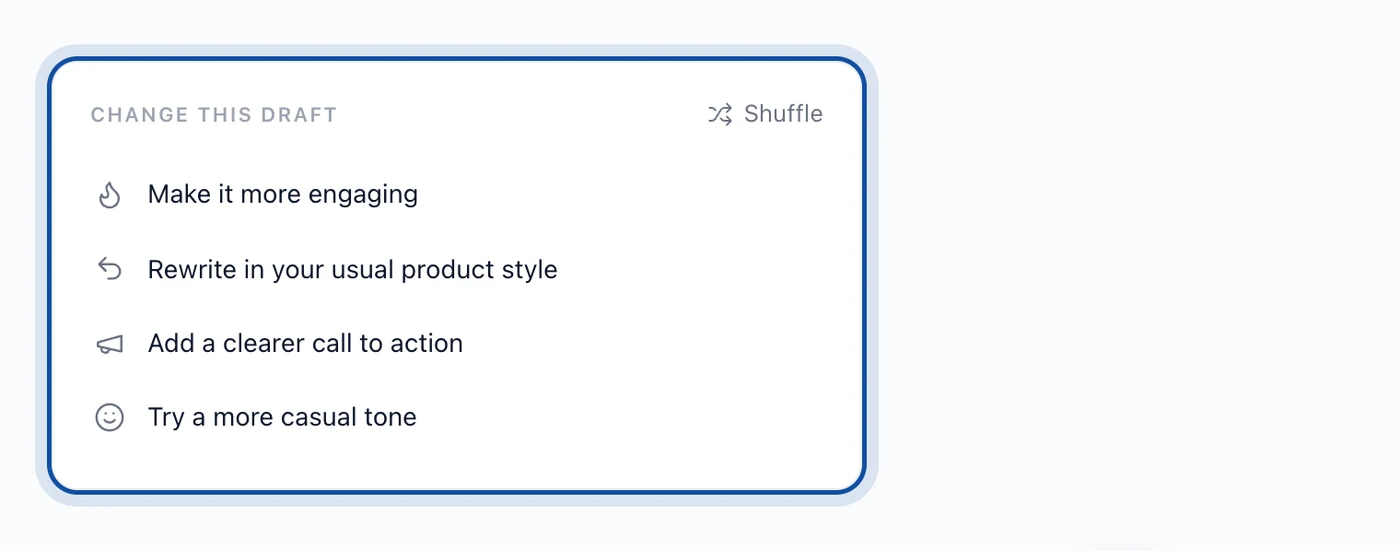
"Make it shorter and punchier and more professional and add a hook" is four instructions that partly contradict each other, and what you get back is the average of all four.
Ask for one.
- *Cut it by half.* Then read it.
- *Sharpen the opening line.* Then read it.
- *Make it more casual.* Then read it.
Three edits you can judge one at a time beat one compound edit you can't.
After: the four checks
Run every draft through these before it publishes. Takes under a minute and catches nearly everything.
- The opening. Does the first line make a specific claim? If it's setting up a claim rather than making one, delete it. The second line is usually the real opening.
- The claims. Is every factual statement true, and yours to make? Models produce confident, plausible, wrong numbers. This is the check that matters most.
- The banned list. Search for the words you never use. If your rules are in brand memory this should mostly come back clean, but it's worth confirming.
- The specifics. Are the numbers, names and concrete details still in there? Rewrites sand these off, and they're usually the reason the post was worth reading.
Close the loop
The most useful habit here is a small one. When you catch yourself making the same edit twice, stop fixing it and write it down instead.
Changed "leverage" to "use" twice? That's a rule. Deleted the closing question three times? Also a rule. Each one you add is an edit you never make again, and brand memory only gets better if you put things in it, because Hyvo doesn't infer rules from your corrections on its own.
Where people get this wrong
- Judging AI on its first draft. The first draft is raw material. The comparison that matters is a good draft in ten minutes versus a good draft in forty.
- Using it for the wrong jobs. It's strong at drafting, restructuring, shortening, and moving a post between networks. It's weak at knowing what happened at your company this week.
- Letting it invent evidence. If you can't point at where a number came from, cut the number.
- Publishing without reading it out loud. Fastest voice test there is. If you wouldn't say it, it isn't your voice.
FAQs
Will AI ever sound exactly like me?
Close, with good rules and a specific brief. The last ten percent is usually a human edit, and that's a reasonable place for the line to sit.
Does Hyvo learn my voice from the edits I make?
No. Brand memory is what you've written plus what was read off your website. Corrections you want remembered need adding to it.
Can I stop Hyvo using certain words?
Yes. List them in Anything else Hyvo should know, or as a standing rule under Instructions for Hyvo.
Do the networks penalise AI-written content?
They reward engagement, not authorship. Generic content does badly because it's generic, which is the same reason generic human writing does badly.
Do I need Premium to use AI on my drafts?
No. Chat and AI Assist are on every plan, with 30 AI requests a month on free. Agent mode and research come with Premium. See how Hyvo AI works.
About the author

Founder, Hyvo
Subarna Basnet is the founder of Hyvo, an AI-powered platform helping businesses create, manage, and automate social media marketing. He writes about AI, social media automation, content creation, and marketing technology.