How to Create a Consistent Brand Voice
Turning a vague sense of how you sound into rules you can hand to somebody else, or to a model, instead of something you can only recognise when you see it.


Quick guide
Write down how you sound as specific rules (words you use, words you never use, sentence length, how you handle claims), then keep them somewhere every draft can read them.
- Pull ten posts you were happy with and work out what they've got in common.
- Write the tone as three or four concrete adjectives, not one vague one.
- List the words and habits you never use. Most guidelines skip this half, and it's the half that does the work.
- Put it in Settings → Memory: brand name, industry, audience, tone of voice, what you do, and anything else Hyvo should know.
- Add standing rules under Instructions for Hyvo, which apply whenever it writes or schedules for you.
The full walkthrough is below.
Most brand voice documents are useless. They say "friendly but professional" and "authentic", then somebody writes a post, somebody else says it doesn't sound right, and neither of them can point at the line in the document that explains why.
A voice is only worth having if you can hand it over: to a new hire, a freelancer, or a model. So this is about turning a feeling into rules specific enough to hand over, and then keeping them somewhere they get used automatically.
What a brand voice actually is
Not a personality. A set of choices you make the same way every time:
- Vocabulary. The words you reach for, and the ones you refuse.
- Sentence shape. Short and flat, or longer and qualified.
- Stance. Whether you make claims, hedge them, or show evidence instead.
- Distance. Whether you say "we", "I", or neither.
- Humour. How much, and whether it's ever at somebody's expense.
You already make every one of those choices without thinking about it. Writing them down is the whole exercise.
Step 1: Read your own good posts
Pull ten posts you were genuinely happy with. Not the best performing ones, the ones that sounded like you. Read them together and answer three questions:
- What do the openings have in common? A number, a claim, a question, a story?
- How long's the average sentence? Count one post's worth if you're not sure.
- What's never in them? Exclamation marks, superlatives, emoji, the word "excited"?
That third question is the one that produces useful material, and it's the one voice documents almost never bother to answer.
Step 2: Write the tone as adjectives you could argue with
"Professional" tells nobody anything. Three or four adjectives somebody could plausibly disagree with actually tell a writer what to do.
Compare *friendly and professional* against *plain, direct, a little warm, never salesy*. The second one rules things out, and ruling things out is what makes it usable.
A good test: could somebody write one sentence that obeys your adjectives and one that breaks them? If not, the adjectives are just decoration.
Step 3: Write the rules that rule things out
The negative half is where consistency actually comes from. Roughly this shape:
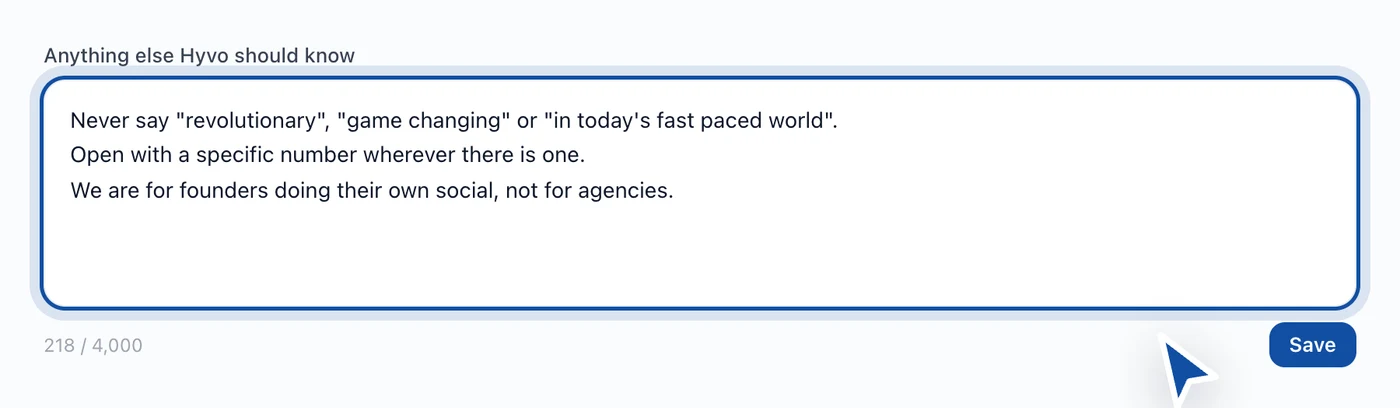
- Never use "revolutionary", "game changing", or "in today's fast paced world".
- Open with a specific number wherever there is one.
- No more than one emoji per post, and never in the first line.
- Never claim a result we can't point at.
- We're for founders doing their own social, not for agencies.
Five rules that specific do more than a page of principles ever will.
Step 4: Store it in brand memory
Hyvo keeps this in Settings → Memory. It gets trained from your website to start with, and everything it comes up with is yours to correct.
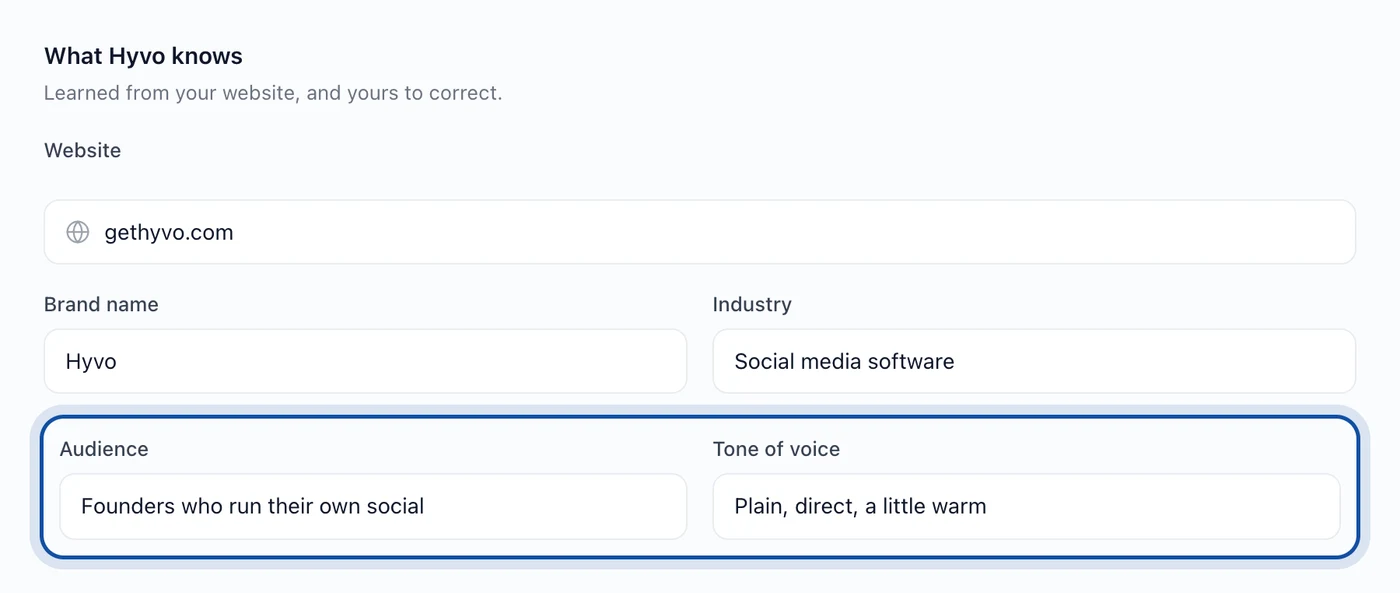
The fields are:
| Field | What goes in it |
|---|---|
| Brand name | What you call yourself |
| Industry | A plain description, not a category |
| Audience | Who you're writing for, specifically |
| Tone of voice | Your three or four adjectives |
| What you do | What you make, and who it's for |
| Anything else Hyvo should know | Products, launches, words you avoid, claims you can't make |
That last field is where the negative rules go, and it's worth more than the other five put together.
Step 5: Add standing instructions
Under brand memory sits Instructions for Hyvo, rules it should follow whenever it writes or schedules for you. There's room for 4,000 characters, which is far more than you'll need.
The difference between the two fields is worth getting straight. Brand memory is what you *are*. Instructions are what Hyvo should *do*. "We're for founders doing their own social" is memory. "Don't schedule posts at weekends" is an instruction.
Keeping it honest
A voice document goes stale the same way a calendar does. Two habits keep it current.
When you rewrite an AI draft, ask yourself why. If you've changed the same thing twice, that's a missing rule. Add it.
When something lands unusually well, read it for voice. Every so often a post works because it broke a rule you don't believe in any more.
Hyvo won't pick these up on its own. Brand memory is what you've written plus what was read off your website, so it stays accurate because you keep it accurate. There's a Reset memory control if you ever want to start again from the website. It clears what Hyvo knows without touching your posts, accounts or analytics.
Where voice documents go wrong
- Adjectives everybody would agree with. If nobody could disagree, it constrains nothing.
- Only writing what you are. The rules about what you never do are the ones that produce consistency.
- Describing an aspiration. Write the voice you've actually got. A voice you have to perform won't survive a busy week.
- Filling it in once and never opening it again. Ten minutes a quarter keeps it worth having.
FAQs
How long should a brand voice document be?
Short enough that somebody reads all of it. Three or four adjectives and five to ten rules is usually plenty.
Does Hyvo learn my voice from my social posts?
No. Brand memory is trained from your website and edited by you. Connected accounts are for publishing and measuring. Describing somebody back to themselves from their own posts isn't something we do.
What's the difference between brand memory and Instructions for Hyvo?
Memory is what you are: audience, tone, what you make. Instructions are rules for what Hyvo should do when it writes or schedules.
Can I have a different voice per network?
Brand memory is one per workspace, but you can note per-network rules inside it, and you can always rewrite an individual post per channel in the composer.
Will AI drafts sound like me straight away?
Closer, not identical. Using AI without losing your brand voice covers what to check before you publish.
About the author

Founder, Hyvo
Subarna Basnet is the founder of Hyvo, an AI-powered platform helping businesses create, manage, and automate social media marketing. He writes about AI, social media automation, content creation, and marketing technology.