AI-Powered Social Media Management: The 4 Layers That Actually Matter
Every tool says AI-powered now. They mean four completely different things, and only two of them are worth paying for. Here they are, in ascending order of value.

Quick guide
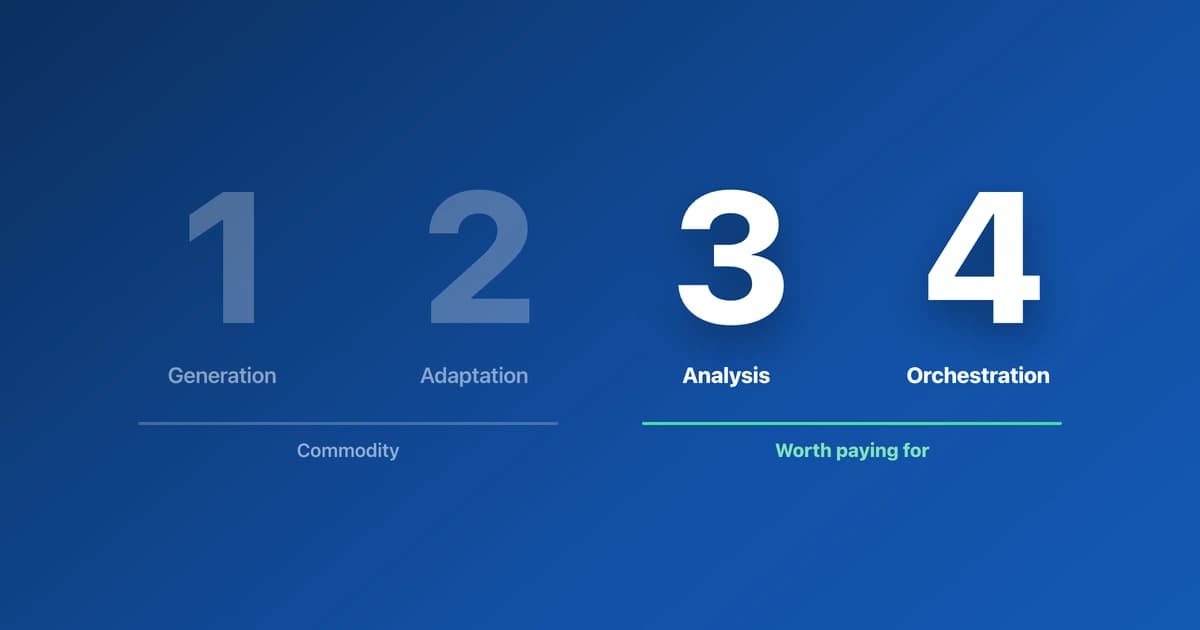
AI-powered social media management is four layers stacked on each other: generation writes drafts, adaptation reshapes one idea per network, analysis reads your own results, and orchestration runs routines on a trigger. Layers 1 and 2 are commodities. Layers 3 and 4 are what you are actually paying for, and both are worthless if the AI cannot see your account.
- Ask what the AI can see before you ask how well it writes.
- Treat draft generation as a commodity. Every tool has the same models.
- Use adaptation for per-channel rewriting. It is the hidden time-saver.
- Buy for analysis against your own median, with the sample size shown.
- Require any routine that publishes to stop and wait for a person.
- Walk away from any tool that states findings without saying how much data is behind them.
The full walkthrough is below.
Every tool on the market says "AI-powered" now. Having built one, I can tell you the phrase covers four completely different capabilities, and only two of them are worth paying for.
If you are shopping for an AI-powered social media management tool for small teams, that distinction is the whole decision. A two-person team does not need a better caption generator. You need the thing that removes the hour you lose every week to mechanical work, and the thing that tells you which of your posts actually worked.
Here are the four layers, in ascending order of how much they change your week:
- Layer 1: Generation — it writes drafts
- Layer 2: Adaptation — it rewrites one idea per channel
- Layer 3: Analysis — it reads your results
- Layer 4: Orchestration — it runs routines and waits for approval
Almost every tool sells you Layer 1. It is the cheapest to build and the easiest to demo.
We built Hyvo AI the other way round. It starts by reading your own published posts, your own numbers and your own brand rules, and only then writes anything. That ordering is the entire argument of this page, and I will show you how to test it on any tool in about thirty seconds.
Contents
- Why "AI-powered" means nothing now
- Layer 1: Generation, it writes drafts
- Layer 2: Adaptation, it rewrites one idea per channel
- Layer 3: Analysis, it reads your results, not the internet
- Layer 4: Orchestration, it runs routines and waits for approval
- The four layers compared
- What AI-powered social media management is not
- Judge any AI-powered social media management tool for small teams
- FAQs
Why "AI-powered" means nothing now
The phrase got diluted because it was never defined.
Two years ago, adding AI to a social media tool meant real engineering. Today you can wire a scheduler to a model API in an afternoon and put "AI-powered" on the pricing page by Friday. Both products get described identically.
So you end up comparing two things that share a label and nothing else:
- A scheduler with a model bolted on. You type a topic, it returns a caption. It has never seen a single post you published. It does not know your audience, your voice, or whether your last twelve posts did well.
- A system that reads your account. It knows which of your posts beat your own average, what those posts had in common, and how many posts that pattern is based on.
Both say "AI-powered". One of them is a text box.
Here is the thing nobody puts in a comparison table: the difference is not the model. It is what the AI can see.
Every serious tool is calling the same handful of frontier models. Nobody has a secret model that writes better captions. What they have, or do not have, is context: your posts, your numbers, your rules, your calendar.
A model with no context produces the statistically average post about your topic. That is not a flaw in the model. It is doing exactly what it was asked to do with what it was given, and what it was given was a topic and nothing else.
Which means the entire question of whether an AI social media tool is any good collapses into one thing you can test in a trial. I will come back to that in Layer 3.
Layer 1: Generation, it writes drafts
The one every tool leads with. You describe a post, the model writes it.
What it is: prompt in, draft out. A topic, maybe a tone setting, and you get 150 words back.
Why it is the weakest layer: it is a commodity. The underlying models are largely the same across every product in this category, the prompt is short, and there is very little room for one company to be meaningfully better than another at it.
It is also where nearly all the disappointment with AI content comes from. Generic input produces generic output. A caption generated from a topic and nothing else reads exactly like a caption generated from a topic and nothing else, and your audience clocks it immediately.
Here is what that looks like in practice.
Generic, from a topic:
> "In today's fast-paced digital landscape, having a strong content strategy is more important than ever. Consistency is key to social media success! What's your biggest content challenge? Let us know in the comments."
Specific, from context:
> "We cut our content calendar by 40% last quarter and our reach went up. The posts we removed were the ones written to fill a slot rather than because we had something to say. Turns out the algorithm agrees with the reader."
The second one is not better because a better model wrote it. It is better because it contains a decision somebody actually made and a number somebody can check. No model invents that from the word "content strategy".
Is Layer 1 useful? Yes, genuinely, when the page is empty and you are stuck. Getting a bad first draft on screen in ten seconds beats staring at a cursor for twenty minutes.
Is it a reason to choose one tool over another? No. Every tool does this, and they all do it about equally well. If a demo spends most of its time here, you are watching the cheapest part of the product.
Layer 2: Adaptation, it rewrites one idea per channel
This is the hidden time-saver. Nobody advertises it, and for a small team it is the layer that gives you an hour back every week.
Here is a Tuesday from an actual social media week.
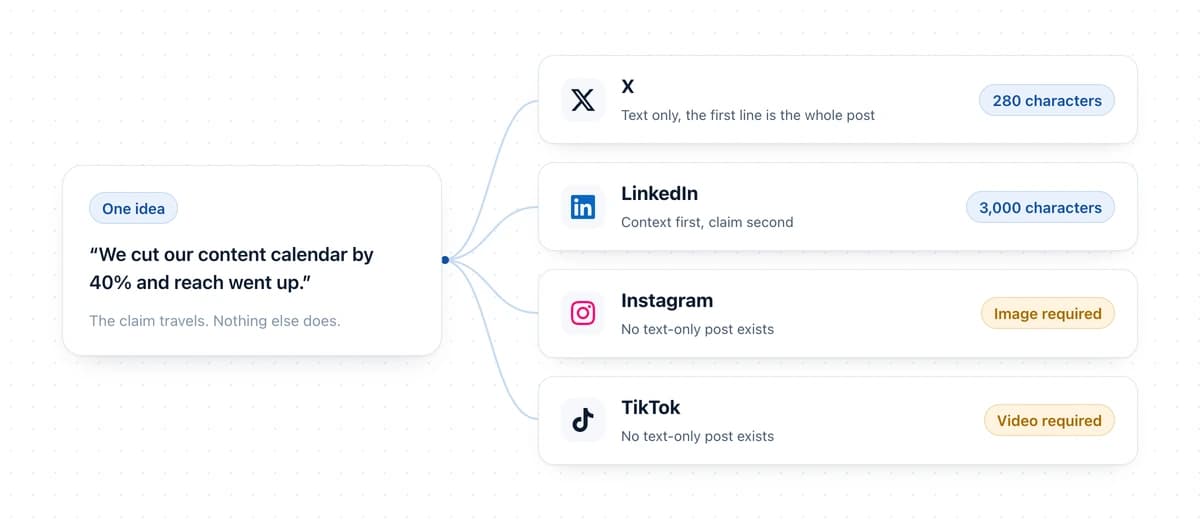
You have one thing to say. It is a good idea. Now:
- X needs it in 280 characters, and the first line has to be the whole point
- LinkedIn gives you 3,000 characters, and the first line is all anyone sees before "see more"
- Instagram will not accept the post at all without an image
- TikTok will not accept it without a video
That is not four ideas. That is one idea and four formatting problems. And it is roughly fifteen minutes of work that requires no creativity, produces no satisfaction, and is the single most-skipped step in social media — which is exactly why so many feeds are full of identical cross-posts that read as lazy on three networks out of four.
Why AI is genuinely good at this: it is a narrow transformation with a clear right answer. Cut this to 280 characters without losing the point. Turn this punchy line into something that does not read as flippant in a professional feed. Add two sentences of context in front of this claim.
Those are formatting jobs, not creative ones. There is a correct answer and the model can find it. Compare that to Layer 1, where "write something good about our product" has no correct answer at all.
What to look for: whether the tool knows each network's real constraints, not approximate ones. Character limits differ by a factor of 225 across the networks we publish to. Three of them reject a text-only post outright. A tool that does not enforce that in the composer will let you schedule something that fails at nine on a Friday morning.
How Hyvo does it: the composer keeps one draft with a separate version per channel. You write once, and the channel tabs let you rewrite the two that need it without touching the rest.
The preview draws each network in its own layout, side by side, so you can read all four versions before anything is scheduled. The character counter reads the real limit for the specific account you are previewing, not the strictest limit in your set.
AI Assist works against whichever channel is in the preview. Ask it to shorten and it shortens to that network's limit and habits, rather than to a generic average. See how the composer works.
Layer 3: Analysis, it reads your results, not the internet
This is our moat, and I will be direct about why.
Here is where useful and useless AI part company completely.
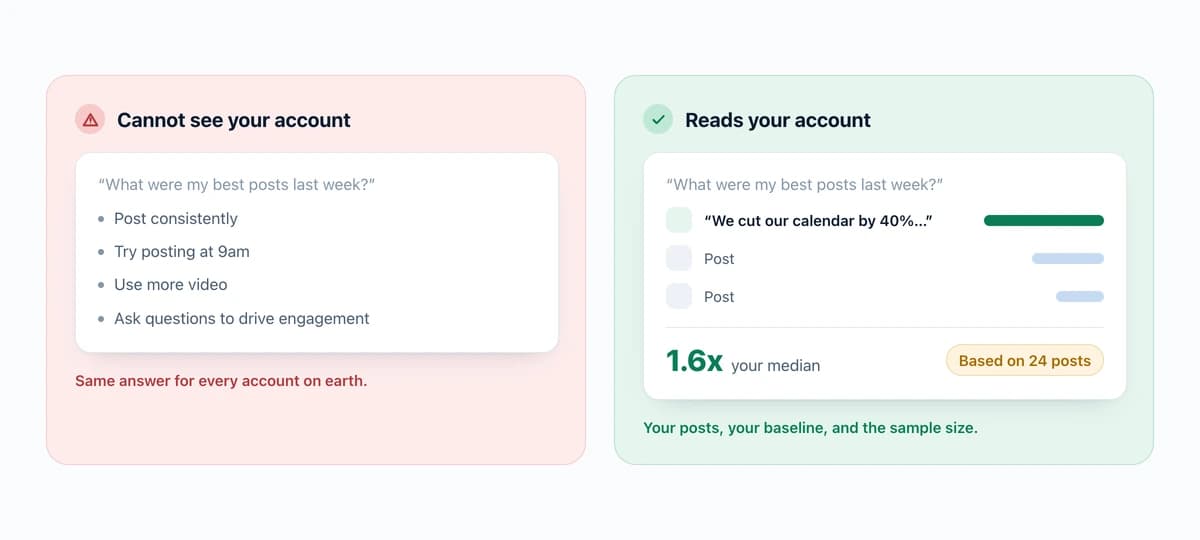
Bad AI is a chat window with a logo on it. Ask it what is working on your account and it says: post consistently, use video, try posting at 9am, ask questions to drive engagement.
That is not advice. That is a summary of every social media blog post ever written, and it would be identical if you ran a bakery or a B2B database company. It cannot be wrong because it never says anything specific enough to be wrong.
Good AI answers with your account. Which of your posts beat your own median last month. What those posts had in common. How many posts that conclusion is based on.
The baseline is the whole game
Most tools compare you to an industry benchmark. "The average engagement rate on LinkedIn is 2%."
That number is drawn from millions of accounts of every size, in every industry, posting at every frequency. Your account is one of them. It cannot tell you whether your Tuesday post did well.
The only baseline that means anything is your own median. A post that ran at 1.6 times your median did well for you. That is a claim you can act on.
Median rather than average, incidentally, because one unusually good post drags an average up and then everything afterwards looks like a decline.
How to tell a real pattern from a coincidence
Two rules, and almost nobody applies the second one.
Rule one: count the posts. A difference between two posts is nothing. A difference between two groups of twenty is worth looking at.
| Posts in the group | What you can honestly say |
|---|---|
| Under 10 | Nothing. Genuinely nothing. |
| 10 to 25 | A direction worth testing deliberately |
| 25 to 100 | A pattern, if the gap is large |
| Over 100 | A property of your account |
Most patterns people reorganise their quarter around sit in the first band. "Posts with questions do better" drawn from six posts is a story, and it feels convincing precisely because you can remember all six.
Rule two: hold the other variables still. This is the trap, and here is the second example from a real week.
Month end. You pull your numbers and video is beating text by a mile. Obvious conclusion: make more video.
But think about what actually happened. Video is expensive, so you only made videos for your best three ideas. Text got everything else, including the filler.
You did not measure format. You measured idea quality wearing a format's clothes.
You cannot eliminate that without a real experiment — make video for material you would otherwise have posted as text, for a month, and see if the gap survives. Most gaps do not, and finding that out costs a month instead of a quarter. Turning analytics into one decision is that loop written out properly.
The one question that sorts every tool
Ask this in your trial: "Which of my posts did best last month, and why?"
- If it answers with your posts and your numbers, it can see your account.
- If it answers with general advice about hooks and posting times, it cannot.
Thirty seconds, and it tells you more than any feature comparison, because Layer 4 sits on top of Layer 3. An orchestration layer running on ungrounded analysis will confidently act on a six-post pattern every Monday and never mention the sample was thin.
What Hyvo AI can actually see
Stated plainly, because this is the claim the rest of the product rests on:
- Your published posts, with the numbers each one picked up
- Your scheduled posts and drafts, so "what is coming up" is a real answer
- Your analytics, including your own medians, so "good" means good for you
- Your inbox, so it knows what is genuinely waiting for a reply
- Your brand memory — your audience, tone of voice, what you do, and the words you never want used
- The screen you asked from, so a question on analytics with a date range selected gets answered for that range
It also tells you when the data is thin instead of rounding up to a confident claim. That is a product decision that makes demos worse and Tuesdays better.
Layer 4: Orchestration, it runs routines and waits for approval
The newest layer, and the one with the widest gap between the demo and reality.
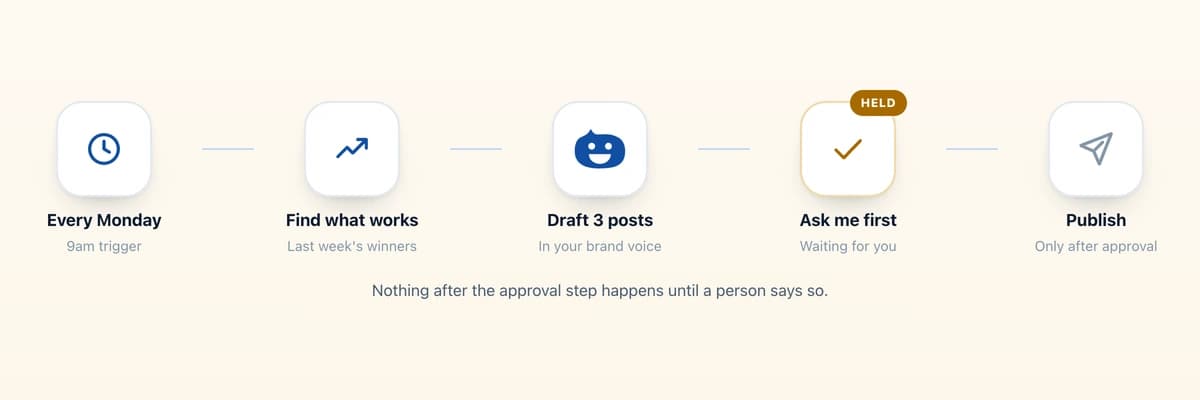
What it is: you describe a routine and the system runs it on a trigger. "Every Monday, look at last week's best-performing posts, draft three more like them, and hold them for my approval."
That is real, it works, and for a small team it is the difference between having a weekly planning session and not.
The failure mode is the same pitch with the last clause removed. "AI runs your social media while you sleep" is a great demo and a bad Tuesday.
The arithmetic is not close. Reading three drafts on a Monday morning costs you sixty seconds. One bad post published under your brand name costs you a screenshot that outlives the deletion. Trading the first to avoid the second is a bad deal in both directions.
The success mode is a workflow that can stop. In Hyvo the block is called Ask me first, and it holds the run until you approve or skip it. Nothing after it happens in the meantime.
Put it in front of anything that publishes. Plenty of workflows keep it forever, and that is not a training wheel — it is the minute that makes the other fifty-nine trustworthy.
A system that cannot pause is not autonomous. It is unsupervised.
Chat and Agent. Hyvo AI has two modes sharing one conversation, and the split matters for how you use this layer.
- Chat answers a question, now. A draft, a read on your numbers, what is on the calendar.
- Agent takes a whole job and returns it finished. A performance report, a fortnight's content plan with the posts drafted, a campaign planned end to end.
The line to remember: "what should I post this week?" is Chat. "Write next week's posts" is Agent.
The four layers compared
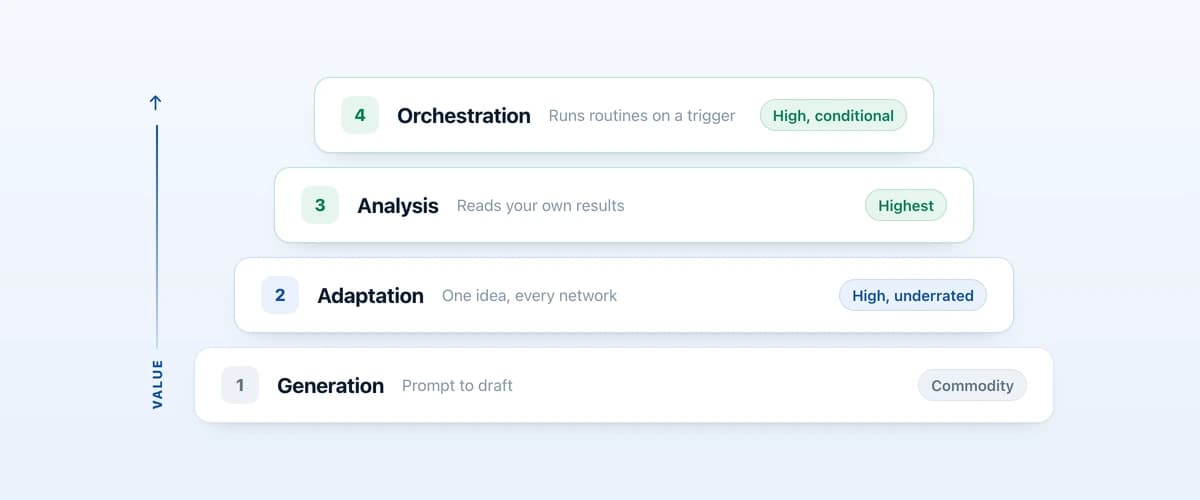
| Layer | What it does | Time it saves | Value | What to look for |
|---|---|---|---|---|
| 1. Generation | Prompt to draft | Minutes on a blank page | Commodity | Does the draft contain anything the model could not have invented? |
| 2. Adaptation | One idea, every network | ~15 minutes per multi-channel post | High, underrated | Does it enforce each network's real limits and media rules? |
| 3. Analysis | Reads your own results | Work you were never going to do by hand | Highest | Can it see your posts? Does it state a baseline and a sample size? |
| 4. Orchestration | Runs routines on a trigger | Your weekly planning session | High, conditional | Can a run stop and wait for a person? |
The time figures are arithmetic from the work itself, not survey data. Fifteen minutes is what four hand-written channel versions of one post actually take.
What AI-powered social media management is not
Three myths worth killing, because all three get sold.
1. It does not mean auto-posting without you.
Anything that publishes without a human read is a liability dressed as a feature. Scheduling is fine. Generating and publishing unread is not, and the saving is one click.
2. It does not mean strategy.
No model knows why your business exists, who your competitors actually are, or that this quarter depends on one enterprise deal that social media has nothing to do with.
It can tell you which of your posts worked. It cannot tell you whether working on social media is the right use of your Tuesday. That gap is not a temporary limitation, it is a category difference.
3. It does not mean image generation.
Some tools generate images. Plenty do not, including ours — media is uploaded from your own machine.
That is a separate product decision from writing, adapting and analysing, and bundling them under one label is how "AI-powered" stopped meaning anything in the first place.
One more, since it comes up constantly: it does not mean replies. A reply is a conversation with a person. The most damaging automation you can run is the one that answers a complaint with a template, and everyone can tell.
Judge any AI-powered social media management tool for small teams
Four questions, in the order the answers matter. Each one tests a layer.
1. What can its AI see? Your published posts and your numbers, or nothing but the sentence you typed? Ask it which posts did best last month. (Tests Layer 3, and everything built on it.)
2. Does it know your voice from written rules, or is it guessing? There should be a place you write down your audience, your tone, and the words you never use — and it should apply to every draft. (Tests Layer 1.)
3. Can an automated routine stop and wait for you? If there is no approval step, the tool is asking you to trust unread output with your brand name on it. (Tests Layer 4.)
4. Does it tell you when it is not confident? A tool that says "based on 24 posts, treat this as a direction rather than a rule" is more useful than one that states everything with equal certainty, because it lets you tell findings apart. (Tests whether Layer 3 is honest.)
That fourth question is the one that separates a product built by people who have run an account from one built by people who have not. Google's own guidance on helpful, people-first content makes the same point about experience and trustworthiness that applies here: stated confidence should match actual evidence.
Where we stand
We built Hyvo around Layers 3 and 4.
Layers 1 and 2 are in there and they work well, but they are not why anyone should choose us. Every tool writes captions and every serious tool will eventually adapt them per network.
What is worth building is an assistant that reads your account before it says anything, states a baseline you can act on, admits when twenty-four posts is not enough to be sure, and stops to ask before it publishes anything under your name.
That is a slower demo. It is a better Tuesday.
FAQs
Is AI social media management worth paying for?
It depends entirely on which layer you are buying. Draft generation alone is not worth much, because every tool uses the same underlying models and you can get the same output free elsewhere.
An assistant that reads your own posts and numbers usually is worth paying for, because it replaces analysis you would otherwise never do. Most people never export a year of posts to a spreadsheet to find out what worked. Now it is one question.
Will AI replace a social media manager?
No. It removes the mechanical half of the job: the reformatting, the summarising, the monthly reporting.
The half that remains is judgement about what to say, what not to say, and what is worth the risk. That was always the actual job, and it is now a larger share of it than before.
Does AI content perform worse?
Unedited AI content performs worse, because it reads like unedited AI content and readers scroll past it.
AI-assisted content, where a person had the idea and the model helped with the shaping, is indistinguishable and much faster to produce. Networks reward engagement, not authorship. Generic content does badly for the same reason generic human writing does badly.
How do I stop AI drafts sounding generic?
Give it something specific to work from. Most genericness comes from a blank context rather than a weak model.
Write down your audience, your tone, and the words you never use, and brief it with a real claim rather than a topic. "Write a LinkedIn post about our content strategy" produces the average post. "Claim: we cut our calendar by 40% and reach went up. Reader: founders doing their own social. Open with the number" cannot produce the average post, because the average post does not contain a 40%. How to use AI without losing your brand voice covers the rules and the four checks before publishing.
About the author

Founder, Hyvo
Subarna Basnet is the founder of Hyvo, an AI-powered platform helping businesses create, manage, and automate social media marketing. He writes about AI, social media automation, content creation, and marketing technology.